
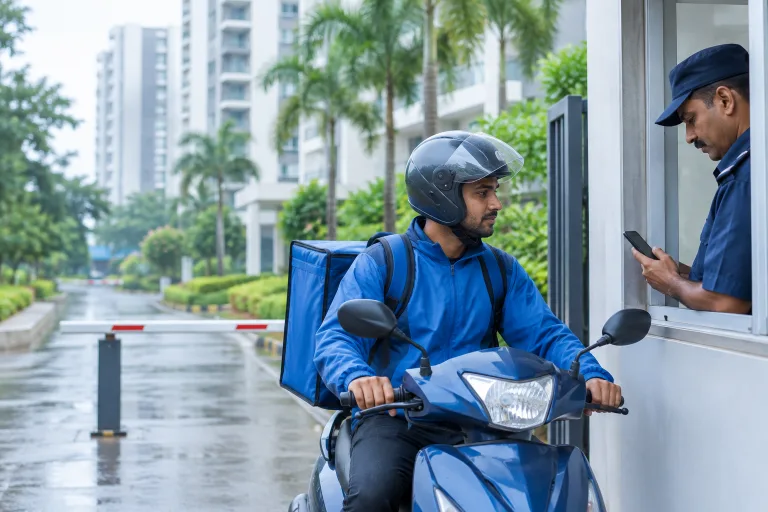
When the pin on the order and the written address point to different places, ask the customer for a Plus Code or a shared location, then check it against the address before you ride. A Plus Code is a short mix of letters and digits standing for one small area on the map, written like "97MF+27" with a place name after it. It works whether or not you have internet, and anyone can create one for free (Plus Codes, as of October 2026). In a city where Cross numbers repeat from block to block and street boards go missing, it settles the "which 1st Cross?" question in one message.
This post is about the phone tool. How Bengaluru layout addresses are built is covered in our address explainer.
What a Plus Code is
- A code for a place, not a street. Plus Codes work like street addresses for places that don't have one, built from latitude and longitude instead of street names and numbers (Plus Codes, as of October 2026).
- Hard to mistype. They use a set of 20 letters and numbers, leave out vowels and characters that are easy to confuse, and are not case-sensitive (same page).
- An area, not a dot. A code stands for a small area, and adding characters after the "+" makes the area smaller (same page).
- A short form for the city. The full code is longer; with a place name attached, the first characters can be dropped. That shortening works when the place is within roughly 40 to 50 km of the named locality (Open Location Code specification, as of October 2026). A short code with "Bengaluru" after it is enough across the city; if a customer sends one without a place name, add "Bengaluru" when you search for it.
How precise is it?
A standard 10-character code covers roughly a 14 by 14 metre patch, which is enough for many locations. In dense housing such as apartment blocks, that patch can take in several homes; an 11-character code narrows it to about 3.4 by 2.7 metres (Open Location Code specification, as of October 2026).
What that means on the ground:
| Where you're delivering | What the code gets you | What you still need |
|---|---|---|
| Independent house on a layout Cross | The right stretch of road, often the right gate | Door number, a landmark |
| Apartment complex | The right building, or the right corner of the campus | Tower, block and flat number |
| Villa layout or big township | The right lane inside the gate | Villa number, the route from the main gate |
| Tech park or campus | The right building | Gate, tower and reception |
Our guides to gated apartments, villa communities around Sarjapur and Varthur and large townships cover the last few metres.
Asking the customer for a location
Customers often don't know what a Plus Code is, so make it easy. A message like this works:
"Hi, I'm your delivery partner and I'm close by. The pin and the address don't match. Can you share your location, or the Plus Code: open Google Maps, put a pin on your gate, tap it and copy the code?"
The steps behind that message come from the Plus Codes site: open Google Maps, drop a pin, tap the "Dropped pin" panel at the bottom to see the code, then copy or share it (Plus Codes, as of October 2026). A shared current location does the same job if the customer is at home. Ask for the gate, not the middle of the building.
Check the code against the address
A code is only as good as where the customer put the pin. Before you ride, put the code into the map and look at where it lands:
- Does it sit in the right block, stage or sector? In Koramangala or HSR Layout the same Cross number turns up in more than one block. If the code lands in one block and the written address says another, call. Our Koramangala guide gives the same advice for a pin that disagrees with the block: trust the written block and ask.
- Is it near the Main and Cross in the address? A code two layouts away means the pin was set somewhere else: an office, a relative's house, the last address.
- Does it sit on a gate or in the middle of a block? If it's in the middle, ask which road the gate is on.
- Keep it to the job. A Plus Code points to someone's home. Use it for this delivery only, and don't forward it.
Make it part of your routine
- Practise once: find the code for a temple, school or metro exit you pass every day.
- Save codes for tricky pickup points you visit often, such as a restaurant's back entrance or a dark store's loading gate.
- When a code saves you a search, note the landmark too, for next time.
Plus Codes sit with DigiLocker for your papers and Sanchar Saathi for a lost phone in our list of free phone tools for Bangalore riders.
Want to work the areas you know best? Apply for a delivery job.
