
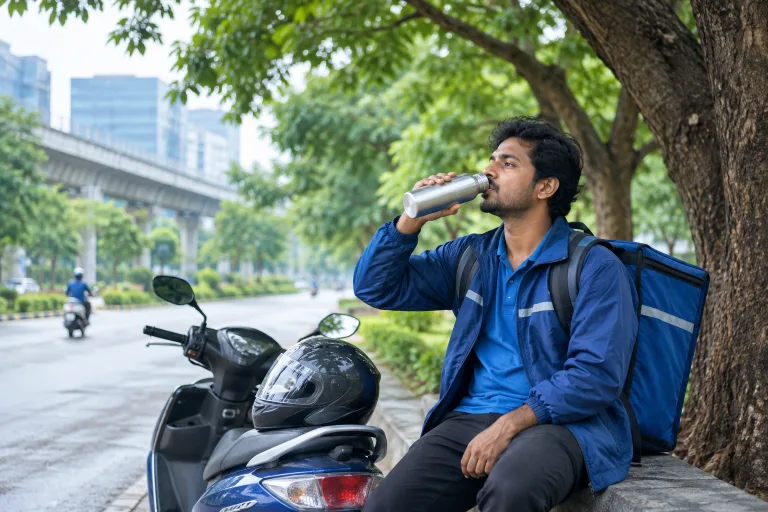
Check the station nearest your zone, not a city average. The Central Pollution Control Board runs the national live AQI portal (CPCB air quality portal, as of October 2026); look up the Bengaluru station closest to where you ride. Up to 100 is "satisfactory" or better. From 101 to 200, "moderately polluted", people with asthma or heart disease may feel it. Above 200 is "poor", and on days like that the Union health ministry says to consider a tightly fitted N95 or N99 (MoHFW air pollution advisory, November 2025, as of October 2026). Last Deepavali, the worst readings reported in Bengaluru were in the low 100s; the year before, one station went past 260 (details below).
Reading the number the right way
The national AQI turns eight pollutants into one number, and the worst pollutant sets it: if one pollutant is in the "poor" range, the AQI is "poor" even if the rest are fine (Indian Economic Service, National AQI, as of October 2026).
It is also an average. Most pollutants are averaged over 24 hours, so the AQI shown at 6 am includes data from 6 am the day before (same source). In plain terms: the reading on the morning after a festival night still carries the cracker smoke from that night. Look again before the evening shift; the number moves through the day.
Bengaluru's monitoring stations
Bengaluru has 14 continuous monitoring stations, 11 run by the Karnataka State Pollution Control Board and 3 by the CPCB, according to a joint committee report filed with the National Green Tribunal in 2025 (NGT, OA 15 of 2025, CPCB reply, as of October 2026). Grouped by part of the city:
| Part of the city | Stations named in the report | Our area pages |
|---|---|---|
| North | Veterinary College, Hebbal | Hebbal |
| Central | City Railway Station; KSPCB office, Saneguruvanahalli | Majestic |
| East | RTO Office, Indiranagar; BWSSB, Kadabeesanahalli | Indiranagar |
| South | Jayanagar 5th Block; BTM Layout; Central Silk Board (HSR Layout 5th Sector); NIMHANS / Institute of Chest Diseases, Hombegowda Nagar | Jayanagar, BTM Layout, Silk Board |
| West | Peenya Industrial Area (two stations); Kavika, Mysuru Road; RV College of Engineering, Mysuru Road | Peenya |
| South-east edge | Jigani Industrial Area | Jigani |
Names on the live page can be shorter or a little different (news reports, for example, quote a Kasturinagar reading).
What each band means if you ride all day
| AQI | Band | Health impact, as the index describes it |
|---|---|---|
| 0–50 | Good | Minimal impact |
| 51–100 | Satisfactory | May cause minor breathing discomfort to sensitive people |
| 101–200 | Moderately polluted | Breathing discomfort for people with lung disease such as asthma; discomfort for people with heart disease, children and older adults |
| 201–300 | Poor | Breathing discomfort on prolonged exposure; discomfort for people with heart disease |
| 301–400 | Very poor | Respiratory illness on prolonged exposure, worse for people with lung or heart disease |
| 401–500 | Severe | Respiratory effects even in healthy people, serious for people with lung or heart disease, even during light activity |
Source: Indian Economic Service, National AQI, as of October 2026. "Prolonged exposure" is the key phrase for a rider: a full shift on the road is exactly that.
What last Deepavali showed
- 21 October 2025, second day of the festival: the pollution board's readings crossed 100 at Majestic (124), Kasturinagar (114), Mailasandra (104) and Saneguruvanahalli (101), while Mysuru Road, Hombegowda Nagar, HSR Layout and Peenya Industrial Area improved (Deccan Herald, 21 October 2025).
- The next report gave Majestic 104 and Mysuru Road 109, and put pollution at Peenya 52% above its pre-festival level. The pollution board called the city's air much better than the previous Deepavali and credited thinner traffic, with many residents away in their hometowns (Deccan Herald, 22 October 2025).
- The year before was worse. On the first day of Deepavali 2024, Hebbal touched 263, Silk Board Junction 170, Jayanagar 136, Mysuru Road 122 and Hombegowda Nagar 121 (same report).
So one Deepavali can stay "moderate" and the next can push a station into "poor". Check every day of the festival week; don't go by last year.
What to do on a bad-air day
The health ministry's November 2025 advisory names outdoor workers, from traffic police and auto drivers to roadside vendors and "others working outdoors", among those at higher risk (MoHFW advisory, as of October 2026). What it advises that a rider can actually use:
- Above 200: the advisory's answer is a disposable N95 or N99 that seals around your nose and mouth, swapped for a fresh one as the pack says. A hanky, a scarf, a cloth or paper mask won't filter this air.
- Where you have a choice of route, avoid roads with slow, heavy traffic and stretches next to polluting industries or construction sites.
- Lung or heart condition? Keep your prescribed medicines within reach, watch for symptoms on days above 200, and see a doctor straight away if they get worse.
A cough that won't settle after the festival is worth a visit to a free clinic; our low-cost health care guide for riders lists where to go. For the festival dates, cracker hours and first aid, start from our Rajyotsava and Deepavali overview.
