
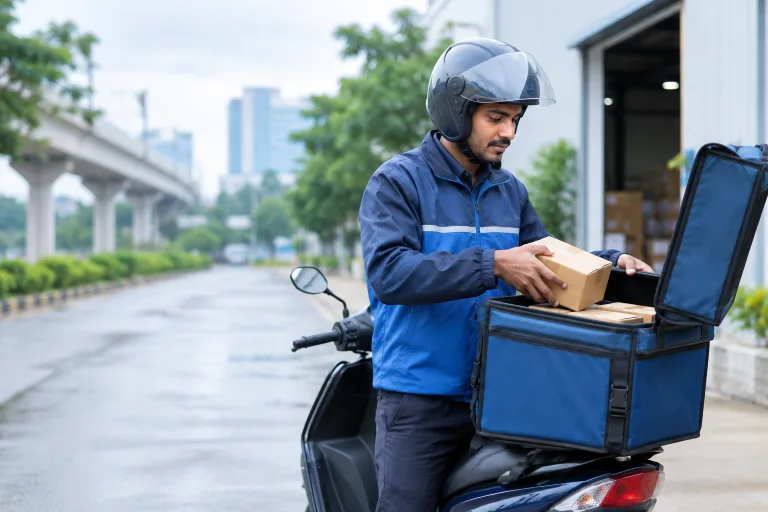
On a cash-on-delivery order, the money in your pocket belongs to the company's client, the seller or platform, and you answer for it until it is deposited. Shadowfax's January 2026 prospectus puts it plainly: its riders collect payments on behalf of its clients, and for COD shipments riders are held financially liable for the value of the item (Shadowfax prospectus on NSE, as of January 2026). Cash is still a large part of the work. In the six months to 30 September 2025, 34.46% of Shadowfax's orders were COD; in FY2023 the share had been 47.00% (same prospectus).
So three habits matter on every COD route: check the notes at the door, deposit on time, and keep the cash out of sight.
How COD money moves, on paper
- At the door you take cash, or the customer pays through a UPI link or QR code. Shadowfax says it offers these digital options to cut the risks of handling cash.
- Afterwards you deposit what you collected through the company's own system. The prospectus describes systems for riders to collect and deposit cash, and vendors that offer cash management services.
- The company holds the money as a limited agent for its client until it is passed on.
All from the prospectus, as of January 2026. The same document shows that gaps are taken seriously: it reports instances of riders depositing less COD money than they collected after successful deliveries, and 71 police FIRs registered against franchise partners, hub in-charges and delivery partners over shipment theft, shipment swapping, cash theft and robbery.
Ask your hub on day one: by when must cash be deposited, where, and what receipt or app entry proves it?
Check the notes before you hand over the parcel
Fake ₹500 notes are on the rise. Banks and the RBI detected 1,41,907 counterfeit ₹500 notes in 2025-26, up 20.5% on the year before, out of 2,29,746 fake notes of all values (Business Today, as of May 2026, from the RBI's annual report).
The RBI's own guide lists what to look for on a genuine ₹500 note (RBI Paisa Bolta Hai, as of October 2026). Checks that take seconds at a gate:
- Tilt it: the windowed security thread changes colour from green to blue.
- Look at the bottom right: the ₹500 numeral is in colour-changing ink, green to blue.
- Hold it to the light: Mahatma Gandhi's portrait and 500 show as watermarks, and the see-through register forms the numeral.
- Look closely: micro letters read "भारत" and "India".
- Feel it: the portrait, Ashoka pillar emblem and the five bleed lines on each side are raised print.
If a note fails, hand it back politely and ask for another note or a UPI payment. You are not accusing anyone; you are protecting your own deposit.
What a bank does with a fake note
Under the RBI's direction to banks, a note found to be counterfeit is never returned and never credited: the bank stamps it "COUNTERFEIT NOTE", impounds it and gives a receipt, even if the person who brought it won't countersign. If a bank finds four or fewer fakes in a single transaction, they go to the police with its month-end report; at five or more, the bank sends them to the police at once and asks for an FIR (RBI Master Direction on Counterfeit Notes, as of September 2026).
For a rider, that means a fake note that slips into your COD cash will never be credited by a bank, and a bundle of them becomes a police case. Checking at the door is cheaper.
UPI at the door
A digital payment only counts once it shows up in the right account. Screenshots, "payment successful" screens and "I sent extra, please refund" requests are covered in our post on UPI tricks at the door. Where your company's app shows its own QR or link, go by what the app confirms.
Carrying cash on the road
Carrying cash can make you a target. In September 2024, Jeevan Bima Nagar police arrested three men who had been picking out delivery executives around HAL, KR Puram and Marathahalli and robbing them; police recovered four motorcycles and a machete (Deccan Herald, as of September 2024). Shadowfax's prospectus also mentions riders robbed of the cash they were carrying (prospectus, as of January 2026).
- Don't count cash in the open. Count it at the door, put it away, ride on.
- Deposit as often as your hub allows, so you carry less late in the day.
- Keep COD cash apart from your own money, so the count at the hub is simple.
- If someone threatens you, let the cash go. Your safety comes first.
- Report it at once: to the police, then to your hub with the complaint copy. Numbers to call are in our Bengaluru helpline list.
What parcel work involves company by company is on our parcel delivery guide, and the four big networks are compared in parcel delivery companies in Bangalore.
