
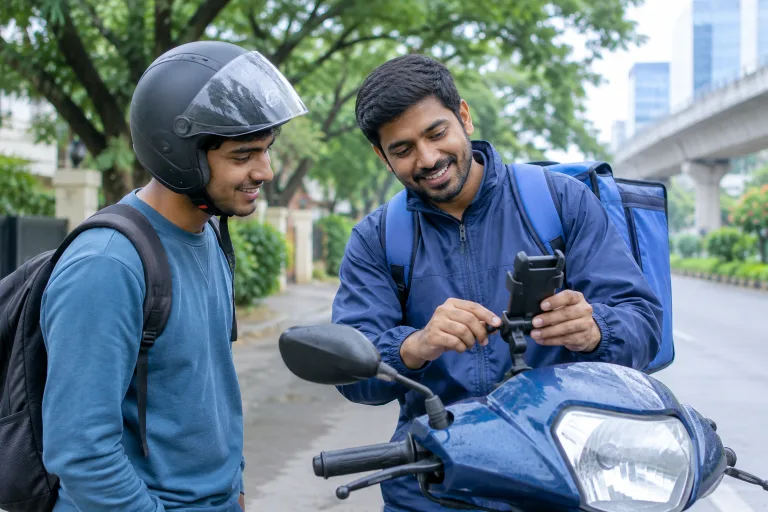
To start delivery work you need to ride safely, use a smartphone app, find addresses and stay polite under time pressure. Months on Bengaluru's roads add more: reading the city, handling difficult customers, managing cash and managing your own day. Those skills show up in the job descriptions for supervisor, quick-commerce operations and EV technician roles. The sections below go through them one by one, with the job that asks for each.
The skills at a glance
| Skill | How delivery builds it | Where it is asked for next |
|---|---|---|
| Navigation and area knowledge | Main, cross and block addresses, one-ways, gated apartments | Hub and dispatch work, route planning |
| Customer handling | Wrong addresses, late orders, calls in two or three languages | Quick-commerce operations, customer support |
| Time management | Peak hours, batched orders, rain delays | Supervisor roles |
| Cash and app handling | Cash on delivery, proof of delivery, order status | Hub work, operations |
| Vehicle care | Daily checks, charging or fuel planning | EV and two-wheeler technician courses |
Navigation: reading Bengaluru
Riders learn the city's address system (main, cross, block, stage) by using it every day. They also learn which roads flood and where the one-ways are. Our post on Bangalore addresses explained covers the system. This knowledge is local, and that is its value: someone hiring for a hub in Whitefield or Jayanagar wants people who already know the streets.
Customer handling: the skill employers name most
A national quick-commerce training standard, approved in October 2025, spells out what customer handling means in this work. It asks trainees to notify customers "proactively about delays due to rerouting or traffic", to give updated arrival times, and to "communicate clearly, politely, and effectively in person, over calls, and through digital support tools". It also asks them to "listen actively and empathize with customer concerns" (NSQF qualification file, Fundamentals of Q-Commerce, as of October 2025). A rider who calls ahead when stuck at a signal is already doing this. The course is 150 hours, and its stated next step is a Q-Commerce Operations Executive role (same source).
Speaking the customer's language helps too. In Bengaluru that often means a few words of Kannada as well as Hindi or English.
Time management and leading others
Supervisors plan who rides where and handle the day's problems. At one parcel company, over 1,500 riders moved into supervisory roles, and riders held over 50% of the supervisor jobs on the ground. The training offered to them covered leadership, communication, conflict resolution, Excel, Google Sheets, report writing, problem solving and customer service (People Matters interview with Delhivery's co-founder, as of February 2025). The lesson for any rider: being on time and keeping things organised gets noticed. A short spreadsheet course is one way to cover the part of that list a rider doesn't learn on the road.
Vehicle care: a route to a trade
If you look after your own scooter, a technician course builds on that. The Karnataka Skill Development Corporation's Jr. Technician (Electric Vehicle) course covers charging an EV battery and checking its health, testing and replacing motors and wiring, and safety on high-voltage systems. It takes 300 hours (qualification file on the National Qualifications Register, read October 2026). Details and other options: EV mechanic course in Bangalore.
How to show these skills
Skills only count if an employer can see them:
- Put them in a skills line on your CV, backed by numbers from your app history: see delivery boy resume.
- Get a certificate for one of them. Free state and central courses are listed in Kaushalya Karnataka for riders.
- Test yourself: the National Career Service portal has a skills test called "NCS Skill Quotient", alongside its job listings and job fairs (NCS, read October 2026).
For the bigger picture, see is a delivery job a good career in Bangalore?. To start building these skills, browse the openings on our jobs page.
