
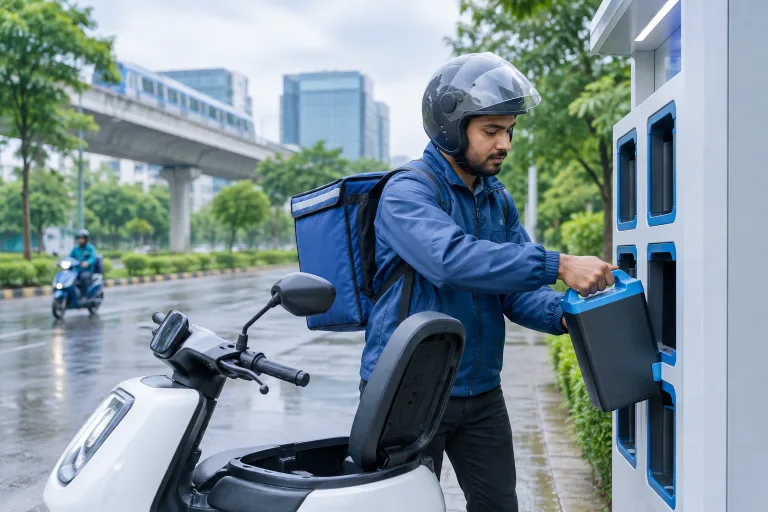
There are three routes into EV repair, from a short course to a two-year trade. The shortest is the Karnataka Skill Development Corporation's Jr. Technician (Electric Vehicle) course, at 300 hours. The longest is the two-year ITI trade, Mechanic Electric Vehicle. Above both sits the EV Service Technician level, with a module on two- and three-wheelers. A rider who already charges, swaps and looks after an EV scooter starts with an advantage. Here is what each route involves.
The three routes at a glance
| Jr. Technician (Electric Vehicle) | ITI: Mechanic Electric Vehicle | EV Service Technician | |
|---|---|---|---|
| Run by | Karnataka Skill Development Corporation (KSDC) | ITIs, under the Directorate General of Training | Automotive Skills Development Council |
| Length | 300 hours, including on-the-job training | Two years | 720 hours, including a 120-hour two/three-wheeler elective |
| Level | NSQF Level 3 | NSQF Level 4 | NSQF Level 4 |
| Certificate | KSDC | National Trade Certificate | ASDC |
Sources: National Qualifications Register, Jr. Technician (EV) (read October 2026); DGT curriculum, Mechanic Electric Vehicle (revised July 2022); ASDC qualification file, EV Service Technician (approved December 2021, rationalised November 2022).
Route 1: KSDC's Jr. Technician (Electric Vehicle)
This is Karnataka's own course, and the shortest route. The 2025 version of the qualification file lists these modules (KSDC qualification file, read October 2026):
- identifying an EV's systems and subsystems;
- selecting, testing and replacing motors, DC-DC converters, relays and wiring;
- charging an EV battery and checking its health;
- safety rules for working on high-voltage systems;
- repair and maintenance, assignments and a mini project.
Grade 10 pass is one entry route. There are also routes for people who left school earlier and have relevant work experience, and the minimum age is 15 (same source). Trainees need 70% overall to pass. The next steps the file names are Technician and then Sr. Technician (Electric Vehicle), or "starting own garages". The National Qualifications Register lists the course as valid until July 2028 (NQR, as of October 2026).
Route 2: the ITI trade, Mechanic Electric Vehicle
This is the full trade course, run through ITIs. It lasts two years, with 1,200 notional training hours each year, and ends with a National Trade Certificate from the Directorate General of Training. The second year covers motors and motor controllers, battery packs, battery management systems, charging systems and regenerative braking. Afterwards the curriculum points to work as an EV technician, then senior technician and supervisor, an apprenticeship, or lateral entry into an engineering diploma (DGT curriculum, revised July 2022).
Two years is a big step if you depend on delivery income. If you are thinking about it, ask the ITI about batch timings and fees before you leave your shifts.
Route 3: EV Service Technician (the next level)
This Level 4 qualification is for repairing and servicing EVs and helping the lead technician find faults. It combines core modules with one vehicle elective. The two/three-wheeler elective covers routine service, minor repairs and help with diagnosis on electric two- and three-wheelers. The next step it names is EV Service Lead Technician (ASDC qualification file, approved December 2021, rationalised November 2022). It suits someone who has finished a shorter course or the ITI trade. Ask the training centre for its current entry rules.
Where to ask in Bengaluru
- Karnataka Skill Development Corporation: 3rd Floor, Kaushalya Bhawan, Dairy Circle, Bangalore 560029, phone 080 2952 2222 (from its qualification file, read October 2026). Ask which centres in the city run the Jr. Technician course and when the next batch starts.
- The state's Kaushalya Karnataka site: it lists the Department of Industrial Training and Employment (the ITIs) among its training arms, and has a candidate registration link (Kaushalya Karnataka, read October 2026). How sign-up works: Kaushalya Karnataka for riders.
Check any course that wants a large fee up front and promises a "job" at the end. Our post on fake delivery job offers explains how to tell real fees from fake ones.
Start from the scooter you ride
Things you already handle as an EV rider (charging, swapping, keeping the battery dry in Bengaluru's rain) are covered in our post on charging and battery swapping for EV delivery riders, with renting in our EV rental guide. A course builds on that day-to-day knowledge.
Where this fits in a longer plan: is a delivery job a good career in Bangalore?. To keep riding while you train, see current openings on our jobs page.
