
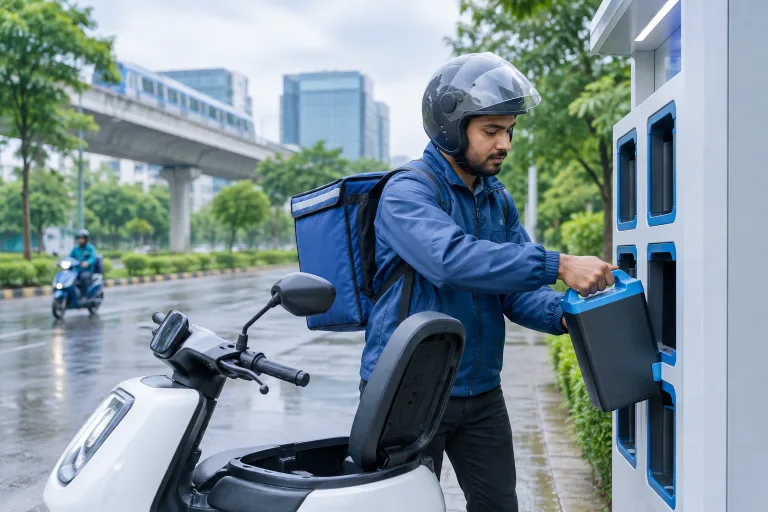
An e-scooter on a Bengaluru delivery shift runs on one of three things: a battery swap network, a public charger, or a socket where you live. Which one works for you depends first on your battery (swappable or fixed) and then on where your hub is. Swapping is the quickest stop but ties you to one network; public chargers are spread across the city but take longer; home charging is the easiest to reach but carries the fire risk. This guide walks through each, with the safety and buying points that come up along the way.
The three options at a glance
| Option | Fits | Watch out for | Read more |
|---|---|---|---|
| Battery swap | Swappable-battery scooters, many rental plans | Only your battery's network works | Swap networks |
| Public charger | Fixed-battery scooters, top-ups between orders | Plug type, queue, price in the app | BESCOM chargers |
| Home or PG socket | A full charge before or after the shift | Wiring, breaker, where you charge | Charging at a PG |
Swap or plug in: choosing for your shift
Start with the scooter you have or can get, because that settles most of it:
- A swappable battery means your day revolves around that network's stations. It suits long shifts with many orders, where a long wait at a charger costs you deliveries. Check the stations near your store before you sign anything.
- A fixed battery means plug-in charging: a full charge at home or the PG, and top-ups at public chargers if the day runs long. It suits shorter shifts, or a hub close to a charger you can rely on.
- A rented scooter often comes with the answer built in. Some rental plans include swaps, others expect you to charge yourself; ask before you take the keys.
Whichever it is, plan your charging around the rush. A stop at a busy swap station or a queue at a charger during the lunch or evening peak is time you are not delivering, so top up in the quieter hours where you can.
Swapping: quickest, but inside one network
A swap takes minutes because you trade an empty battery for a full one instead of waiting. The catch is the network: a swappable battery has to find a station of its own network, as an expert from WRI India pointed out when BESCOM first planned swap stations (Deccan Herald, 21 June 2024, as of October 2026). So the useful number is not how many stations Bengaluru has but how many of yours are near your hub.
IndoFast Energy, a joint venture of SUN Mobility and Indian Oil (Autocar Professional, 9 October 2024), had more than 450 stations in Bengaluru by August 2026 (Autocar Professional, 4 August 2026, as of October 2026). Yuma Energy, spun out of Yulu (TechCrunch, 31 August 2026), opened a swap station at an Instamart dark store in the city in September 2026 (Telangana Today, 23 September 2026, as of October 2026). The full list of operators, the places named in news reports and the questions to ask are in our post on battery-swap networks in Bangalore.
Public chargers: BESCOM and the rest
BESCOM's chargers are only part of the picture. In August 2025 BESCOM's managing director put Karnataka's total at 5,871 charging stations, 4,503 of them in Bengaluru Urban district (Deccan Herald, 16 August 2025, as of October 2026). BESCOM's own chargers are a few hundred, mostly at its offices, RTOs, TTMC bus hubs and civic offices, and its list directs riders to the EV Mitra app (BESCOM charger list, as of October 2026). Other operators have been asked by BESCOM to register their chargers on the national EV Yatra portal (BESCOM advisory, as of October 2026).
On cost, KERC has set the power rate for EV charging connections at ₹4.50 a unit for 2025–28 (KERC tariff charges, as of October 2026); the price on a charger's app can differ, so check it before you plug in. Locations, charger types and how to find a working one are in our post on BESCOM public EV chargers.
Charging at your PG or room
This is where the danger is. In May 2026 a 65-year-old auto driver in Murphy Town was fatally burnt when the battery of a family scooter he had put on charge near where he slept exploded during the night, police said (The News Minute, 13 May 2026, as of October 2026). News Karnataka reported that month that the state had not yet issued dedicated rules for home charging (News Karnataka, 17 May 2026, as of October 2026).
The short version: a proper earthed socket on its own breaker, the scooter's own charger, no extension boards, a spot outside the room you sleep in, and someone awake nearby. What to agree with your PG owner, including how the units are billed, is in our post on charging an EV scooter at your PG safely.
Riding an EV in Bengaluru's rain
Going by Bajaj's Chetak FAQ, a scooter rated IP67 is built to come through a short spell under as much as a metre of water (Chetak FAQ, as of October 2026). That is not the same as riding through a flooded underpass, and the same maker wants the scooter charged only when things are dry. And the top rating doesn't always apply to the whole scooter; on Yamaha's EC-06, for one, the electronics beyond the motor and battery are rated a step lower, at IP65 (Rushlane, 2 February 2026, as of October 2026). Our post on EV scooters in heavy rain covers what to check in your manual, how deep is too deep and what to do if the scooter stops in water.
Which delivery work fits an EV
Some delivery companies have been moving their riders to electric. In June 2025 Zomato's chief sustainability officer said at a Business Today summit that a quarter of its Bengaluru deliveries were on EVs, and that it was piloting charging and swapping at Blinkit dark stores (Business Today, 6 June 2025, as of October 2026). The state is pushing the same way: Karnataka's Clean Mobility Policy 2025–30 names 2030 as the year by which it wants delivery firms' two-wheeler fleets fully switched to clean vehicles (Karnataka Clean Mobility Policy, as of October 2026).
For Flipkart Minutes, two rental routes have been reported: Flipkart's EV Assist marketplace and Bijliride's announced rollout in Bengaluru. Our post on Flipkart Minutes and EVs sets out what each offers, and the Flipkart Minutes company guide covers joining.
Vehicle rules differ by company. Our EV rental guide shows which companies here rent out an EV or accept a rented one, and the Zepto guide sets out what Zepto's rider agreement says about the vehicle.
Renting: is charging in the plan?
If you rent, the charging question is part of the rental. Bijliride, which is rolling out scooters for Flipkart Minutes in Bengaluru, lists battery swapping and doorstep battery delivery among what its riders get (Autocar Professional, 8 October 2026, as of October 2026). Other plans leave charging to you, which brings the PG socket back into the picture. Before you rent, ask:
- does the plan include swaps, and at which stations?
- if not, which charger and socket does the company expect you to use?
- who do you call if the battery runs out or the scooter stops mid-shift?
Our EV rental guide has the rest of the questions, from the deposit to the papers that come with the scooter.
Buying instead of renting
If you buy, a qualifying e-scooter registered by 31 March 2028 can cost up to ₹5,000 less under the central PM E-DRIVE scheme, for as long as its funds last (Autocar India, 12 August 2026, as of October 2026). The state's help is different: no cash top-up in Karnataka's Clean Mobility Policy, but no road tax on an electric two-wheeler (Inc42, 11 April 2026, as of October 2026). How the Aadhaar e-voucher works and who qualifies is in our post on PM E-DRIVE and Karnataka incentives; registration and plates are in our post on EV registration and road tax in Karnataka.
Before your first EV shift
- Know your battery. Swappable (which network?) or fixed (which plug?).
- Map three stops near your hub: a swap station or charger you'll use most, a second one, and where you charge at home.
- Check the price per swap or per unit in the app or plan before the shift.
- Sort the home socket with your PG owner before you first charge there.
- Keep a rain margin. On heavy-rain days, plan routes around flooded stretches and charge only when the scooter and plug are dry.
