
Charge your e-scooter while you are awake and nearby, from an earthed wall socket protected by a breaker, with the scooter's own charger, and never in the room where you sleep. Two recent fires in Bengaluru involved e-scooters charged at home, and one of them killed a man who was asleep near the scooter. As of May 2026 Karnataka had no dedicated rulebook for home charging, so the checks below are on you and your PG owner.
Two fires in Bengaluru
- Murphy Town, May 2026. A 65-year-old auto driver was fatally burnt in his ground-floor home under the Halasuru police limits. Police said he went to bed around 11 pm after plugging in his son's Okinawa electric scooter, and slept in a small room near it. A preliminary inquiry found he switched the charger off after three to four hours; the battery exploded around 3 am. Police suspect it overheated, though a short circuit has not been ruled out (The News Minute, 13 May 2026, as of October 2026).
- Basaveshwaranagar, October 2025. A scooter caught fire while charging at a house late on a Sunday night, and the flames spread to the basement. The owner said it was bought from a local vendor and was out of warranty. Preliminary findings pointed to overcharging and a fault in the automatic power cut-off (Deccan Herald, 13 October 2025, as of October 2026).
A third case shows how a basement fire spreads: in October 2025, 19 electric vehicles were gutted in a basement showroom in Yelachenahalli, off Kanakapura Road, and a fire officer said the blaze may have started at one of the charging points (Deccan Herald, 2 October 2025, as of October 2026).
What the rules say today
After the Murphy Town death, fire officials said the department follows the National Building Code 2016 and that the proposed NBC 2025 guidelines were still awaiting approval. Under those proposals, charging may not be allowed below ground level, and where basements are allowed, only slow or trickle charging could be authorised (News Karnataka, 17 May 2026, as of October 2026). Until something firmer comes, treat a basement charging spot with extra care.
On the scooter itself, the road transport ministry amended the AIS-156 safety standard for L-category electric vehicles, the class scooters belong to, in August 2022, adding requirements for battery packs, on-board chargers and thermal propagation from internal short circuits (Mobility Outlook, 2 September 2022). When you buy or rent, ask whether the battery meets the amended AIS-156 standard.
The socket and the charger
A July 2026 Business Today explainer on charging at home lists the basics (Business Today, 21 July 2026, as of October 2026):
- check with an electrician that the connection can take the load;
- a dedicated circuit, fitted by a trained technician;
- no extension cords, makeshift wiring or adapters;
- an MCB and an RCCB on the circuit, and proper earthing;
- a spot free from moisture and standing water;
- the charger supplied by the manufacturer; stop at any burning smell or damaged cable.
One scooter maker's own rules are just as specific. Bajaj's Chetak FAQ asks owners to charge from an earthed three-pin socket in good condition, in dry and sheltered conditions, with a 10A MCB, with the point installed by a competent electrician, and only with the scooter's genuine charger (Chetak FAQ, as of October 2026). Your own scooter's manual is the reference for your model.
Where to charge in a PG
- Not in or next to where anyone sleeps. The Murphy Town scooter had been put on charge beside the small room where the man slept.
- Not on the stairs or in a passage that people need to get out by.
- Within sight. Plug in when you are home and awake, and unplug when it's done.
What to settle with your PG owner
- Which socket. Ask for one earthed socket on a circuit with an MCB and RCCB, near where the scooter is parked, so the battery never has to come into a room.
- Basement or open parking. Given the proposed NBC 2025 limits on basement charging, an open, ground-level spot is safer.
- How the units are paid for. A normal socket is billed on the building's meter. KERC lets EV users in multi-storey buildings add chargers within the sanctioned load and fit sub-meters billed at the EV tariff (Mercom India, 1 August 2024, as of October 2026). For 2026–27, KERC's approved rate is 450 paise a unit for EV charging connections against 580 paise for a home connection (KERC tariff charges, 2025–28, as of October 2026).
- Put it in a message. A short written note of where and when you may charge avoids arguments later.
Ways to avoid charging indoors
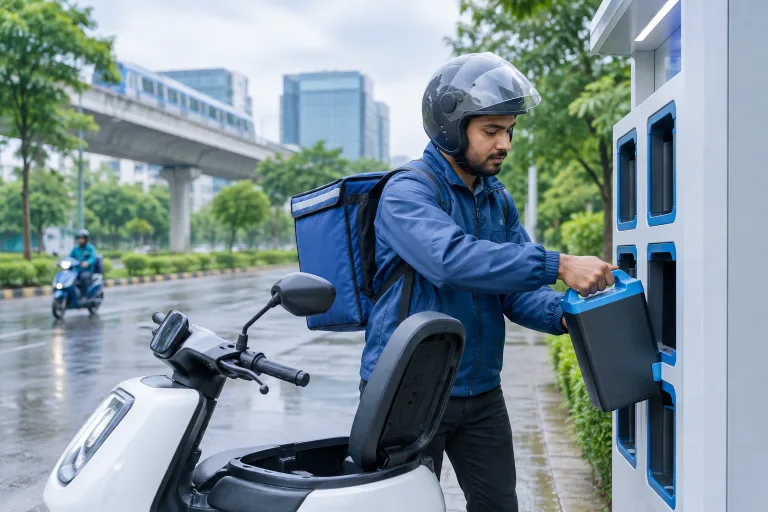
A swap plan means the battery is charged at the station, not in your PG; see our post on battery-swap networks in Bangalore. If you rent, ask the rental company which charger and socket it expects you to use; our EV rental guide lists the other questions.
If a battery smokes, swells or smells of burning, get everyone out and call 112, which covers fire as well as police and ambulance (The News Minute, November 2019); our list of Bengaluru helpline numbers has the details. Public chargers, swap stations and the rain are covered in our main guide to keeping an EV charged on delivery shifts.
