
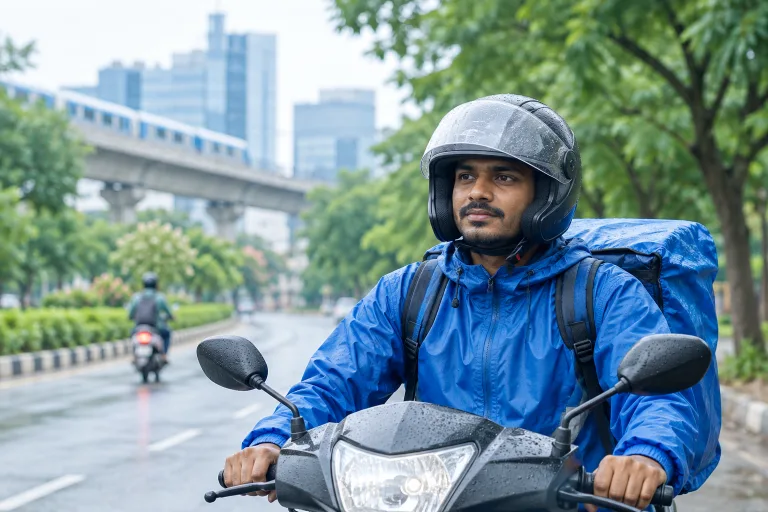
Rain and splashes are what an IP67 rating is meant to handle; a flooded underpass is not. The rating describes a short dunk in water up to a metre deep, it can cover only some parts of the scooter, and the charging point has its own rule: dry conditions only. On Bengaluru's waterlogged stretches, an EV rider should turn back at the same depth a petrol rider would.
What IP67 means
IP ratings have two digits: the first is for dust, the second for water. Bajaj's Chetak brochure spells out its own IP67 rating: 6 means fully dust-tight, 7 means it can be submerged in water up to 1m deep for 30 minutes (Chetak brochure, as of October 2026). Its FAQ puts it more carefully: the rating means it "can withstand submersion in up to one meter of water for a short duration" (Chetak FAQ, as of October 2026).
Read that as a test result, not a riding limit. A sealed pack sitting in water during a test is not a scooter being pushed through moving water full of debris, with the motor running and the wheels churning.
The rating can cover only some parts
Spec sheets don't always rate the whole scooter. Yamaha's EC-06, for example, is IP67-rated for the motor and battery, while its other electronic components are IP65 (Rushlane, 2 February 2026, as of October 2026). Before monsoon riding, check your manual for:
- which parts carry the rating (battery, motor, controller, charging port);
- whether the maker gives a wading depth;
- what it says about water damage and the warranty.
Videos of scooters driving through water are demonstrations, not limits. In 2024 an Ather co-founder shared a clip of a Rizta going through a 400mm water trench (Rushlane, 20 March 2024, as of October 2026). Your own model's manual is the only number to go by.
Bengaluru's flooded stretches
The places to avoid are the same for petrol and electric. Our rain and waterlogging guide lists the junctions, underpasses and service roads the city's corporations flagged in 2026, zone by zone, and our monsoon guide covers the season. Two rules matter more on an EV:
- If you can't see the road surface, don't ride in. Water hides open drains and potholes, and the rating says nothing about either.
- Never ride through water near a fallen line. BESCOM's rain advice and who to call are in our post on live wires in the rain.
Charging after a wet shift
Water on the outside of a sealed battery is one thing; water at the plug is another. Chetak's FAQ says charging must be done in dry conditions, from a sheltered, earthed three-pin socket protected by a 10A MCB (Chetak FAQ, as of October 2026). After a rainy shift:
- Park under cover and wipe the charging port and the plug dry.
- Charge only from a socket that is indoors or roofed, never from a point out in the rain.
- Don't run a charger cable through a puddle or a wet floor.
Our post on charging an EV scooter at a PG safely covers the socket, breaker and charging spot in more detail.
If the scooter stops in water
- Switch it off and walk it out of the water; don't keep pressing the throttle.
- Don't plug it in until it has been checked. Call your service centre, or the rental company if the scooter is rented.
- Take photos of the spot and the scooter before you move it, for any insurance claim. Our post on a bike stalled on a waterlogged road explains what a motor policy usually covers.
Swapping, public chargers and buying help: start from our Bangalore guide to EV charging and battery swapping.
