
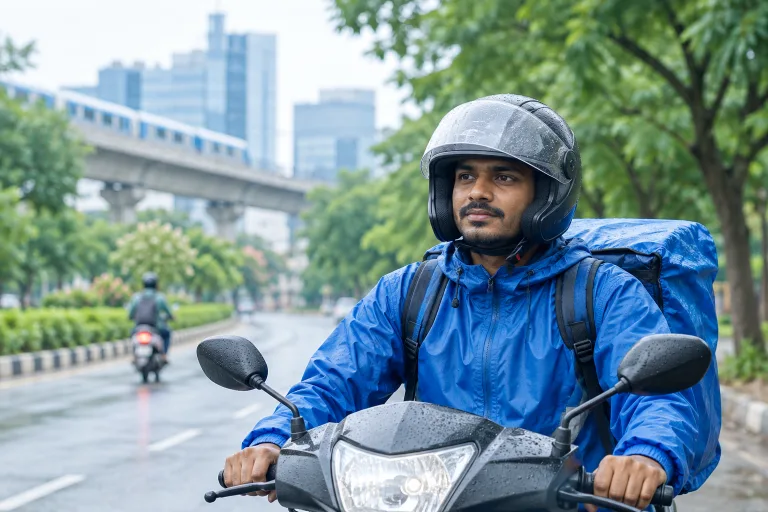
If your bike stops in water, switch off the ignition and don't try to start it again: no self-start, no kick, no push-start. Push it out to higher ground and get a mechanic to drain it first. Insurers say starting a flooded engine is what causes the expensive damage, and a standard bike policy doesn't pay for that damage. An engine-protection add-on can.
In Bengaluru this is not a rare problem. The city's own 2026 lists of waterlogging spots include junctions and underpasses on everyday delivery runs, from HSR Layout to the Panathur underpass; see our rain and waterlogging guide.
Why you must not restart a flooded engine
When floodwater gets into the engine and the vehicle is then "forcibly started", the result is hydrostatic lock, "leading to damage to the engine and finally, breakdown" (Bajaj General Insurance, as of October 2026). The same insurer's flood advice for a two-wheeler is direct: "do not try to start the vehicle by cranking, pushing or kicking". If the vehicle has stood in water for a long time, disconnect the battery and don't restart it, "as it will damage the engine components" (same page).
A bike that stalls and is then restarted can turn a drying-out job into an engine repair, and turn a claim you could make into one the insurer can refuse.
Getting the bike out: step by step
- Ignition off. Don't touch the starter again, even after a few minutes.
- Push the bike out to a higher, dry spot. Keep away from poles, fallen wires and transformers on the way (BESCOM's rain advice).
- Take photos of the bike in or near the water, the water level and the place. Some add-on claims need proof that the vehicle stopped in a waterlogged area (see below).
- Call your insurer before any repair, and a mechanic to drain the engine. Bajaj General's advice is to get an expert technician to inspect the vehicle and remove water from the engine, transmission and electrical parts (same page).
- Tell the hub or the customer you're stuck, and don't ride on until the bike is checked.
What insurance pays for
| Damage | Standard package (comprehensive) policy | Engine-protection add-on |
|---|---|---|
| Flood or inundation damage to the bike | Usually covered under own damage (IRDAI) | Covered |
| Cleaning the engine and parts of water and mud | Covered (Bajaj General) | Covered |
| Engine damage from starting a flooded engine (hydrostatic lock) | Not covered (Bajaj General) | Covered by add-ons such as Bajaj's Engine Protector (same page); HDFC ERGO's add-on lists "engine failure caused by starting a wet engine" (HDFC ERGO) |
| Mechanical or electrical breakdown | Usually excluded (IRDAI) | Depends on the wording |
Sources read in October 2026. Wording differs by insurer, so read your own policy schedule for the add-ons you have.
The conditions in add-on wordings
Digit's engine and gearbox protection add-on for bikes covers damage to the engine's internal parts from "water ingression", but a claim is admissible "only if there is evidence of the vehicle being stopped in a waterlogged area". Its exclusions include a claim notified more than 3 days after the event (unless the insurer accepts the reason for the delay) and repairs done without the insurer's prior approval (Digit, as of October 2026). HDFC ERGO says its engine cover is available with comprehensive or standalone own-damage policies (HDFC ERGO, as of October 2026).
So: photos at the spot, an early call to the insurer, and no repair before approval.
Does it matter that you use the bike for deliveries?
It can. Digit, for one, limits its personal bike policy to personal use and sells a separate commercial policy for two-wheelers used for business, deliveries included (Digit, as of October 2026). If your bike is on a personal policy and you deliver with it, check with your insurer before you need to claim. Our post on bike insurance for delivery use covers this in detail.
Making the claim
IRDAI's guide to motor claims says that for an own-damage claim you must "immediately inform" the insurance company, so that it can send a surveyor to assess the loss (IRDAI policyholder site, as of October 2026).
Papers usually asked for in an own-damage claim, including natural calamity (Zurich Kotak, as of October 2026):
- a copy of the policy or cover note valid on the day,
- a copy of the RC with the tax receipts,
- the claim form, filled in and signed,
- a copy of the driving licence of the person riding,
- the garage's written repair estimate,
- clear photographs of the damaged bike, taken before any repair.
Keep photos of your RC, licence and policy on your phone so you have them at the roadside; our monsoon guide has more on keeping papers dry.
If the claim is refused or stuck, complain to the insurer's own grievance channel first. If that doesn't work, or you can't reach the insurer, IRDAI's Bima Bharosa portal takes complaints against insurance companies (IRDAI, grievance system, as of October 2026).
