
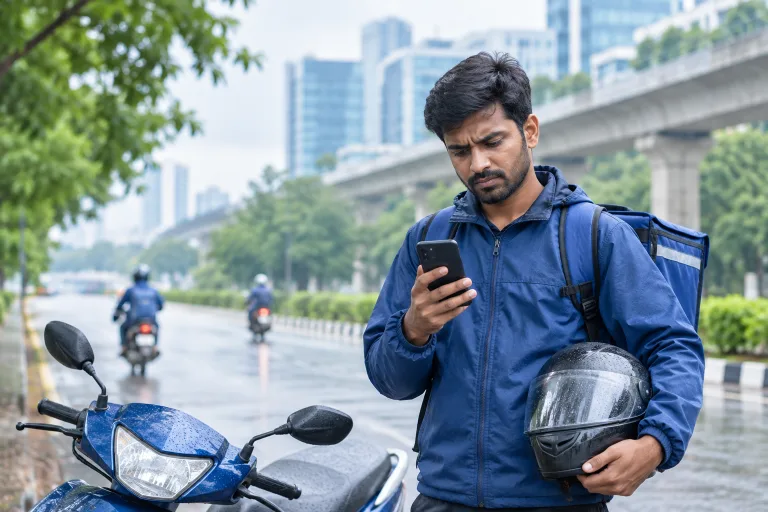
A real delivery job in Bengaluru does not ask you to pay a stranger's UPI ID, buy "tasks", or read out an OTP. If an offer asks for any of these, stop. If you have already paid, call 1930 now: the national cybercrime helpline exists so victims of online money fraud can report fast, and so the money can be frozen where that is still possible (PIB, as of October 2025).
This guide covers the kinds of scam that show up in Bengaluru police data and news reports, a quick way to check any offer, and what to do once money has gone.
The scams at a glance
| Scam | What it looks like | The check | Full guide |
|---|---|---|---|
| "Part-time tasks" | Paid to rate or review; then "prepaid" tasks need your money | Real work never pays you to deposit money first | Task scams |
| Fake recruiter | "HR" from a delivery brand asks for a fee to confirm your slot | No fee to a personal UPI ID or QR code, ever | Fake recruiters |
| Deposit demand | Pay a "deposit" for a bike, EV or kit before you start | Written terms, a receipt and a refund rule, or don't pay | Deposit red flags |
| Loan apps | Instant loan, then threats to your contacts | App on RBI's list, lender named | Loan apps |
| Tricks at the door | Fake "payment done" screen, "refund the extra" | Trust only your own bank or UPI app | UPI tricks |
| OTP calls | A "blocked account" or KYC call that ends with "read me the OTP" | Nobody genuine needs your OTP | OTP fraud |
How big the problem is in Bengaluru
Bengaluru police data for January 2022 to June 2026 shows 59,951 cybercrimes in the city, with losses of ₹5,059 crore (Deccan Herald, as of August 2026). The same report says:
- frauds built on part-time jobs, online tasks and fake reviews rose from 228 cases in 2022 to 2,158 in 2025;
- online money transfer frauds rose from 79 cases in 2022 to 1,197 in 2025, with 656 more in the first half of 2026;
- OTP frauds (fake KYC updates, malicious app links, phishing) fell from 1,860 in 2022 to 617 in 2025, and 392 till June 2026.
Job frauds and advance fee scams are on the list of crimes Bengaluru's cyber police investigate. Besides the Cyber Crime Police Station, the city has 8 CEN (Cyber, Economic and Narcotics) police stations for these cases (Bengaluru City Police, as of October 2026).
1. "Part-time tasks" on WhatsApp and Telegram
It starts with a message about easy part-time work: rate a hotel, review a restaurant. The first small payment is real, and that is the hook. Then you are added to Telegram groups and told that "prepaid" tasks earn more, so you put money in. When you try to withdraw, there is always one more fee.
In Whitefield, a 28-year-old software engineer was paid ₹200 for one restaurant review, then moved to tasks where she put in ₹1,000 and got ₹1,300 back. Between November 3 and 8 she sent ₹23,23,315, and when she tried to withdraw, the scammer demanded more (Deccan Herald, November 2023). Delivery work pays you for orders you deliver. It never asks you to pay in to "unlock" earnings. More cases and the warning signs: Telegram task scams.
2. Fake recruiters using a company's name
A call or WhatsApp message says it is from the HR team of a well-known delivery brand. You are "selected", but you must pay to confirm the slot, verify documents or get your ID card. The I4C, the Home Ministry's cybercrime centre, describes how this kind of scam runs: a message like "Your CV has been selected", a WhatsApp chat link, a registration website, then a request to add money "for verification & registration" (I4C advisory, August 2022).
In one case Delhi Police cracked in June 2025, a fake placement agency promised a man a job at a grocery delivery company. It collected fees for registration, document verification, an agreement, TDS and processing, over ₹9,000 in all, through QR codes, and blocked him when he refused to pay more (The Week, June 2025). How to spot these messages: fake recruiter calls and WhatsApp.
3. Deposits for a bike, an EV or a kit
This one is harder, because some payments in delivery work are real (see "Real fees and fake fees" below). The scam version is a "deposit" a stranger wants before anything is in writing, paid to a personal account, with no receipt and no refund rule.
"Security deposit" was one of the labels in a work-from-home fraud that Udupi police traced to a Yeshwanthpur man in July 2025: a job seeker from Hebri made 98 payments, ₹2.02 lakh in all, before he went to the police (Deccan Herald, July 2025). The checks before you hand over money: deposit red flags.
4. Instant loan apps
Weekly payouts and fuel costs can make a quick loan look tempting. Illegal loan apps ask for access to your contacts and photos, then threaten you and message the people in your contact list, and in cases police have recorded, the demands went on after victims paid. Loan app cases reported in the city fell from 586 in 2022 to 353 in 2023, police data shows (Deccan Herald, February 2024).
The RBI keeps a public list of the digital lending apps that regulated lenders have reported to it (RBI, May 2025). How to check an app and what to do about threats: loan apps and riders.
5. Payment tricks at the customer's door
On cash-on-delivery orders, someone shows you a phone screen that says "payment successful", or asks you to refund an "extra" amount they say they sent. In Byadarahalli, a couple bought ₹1 lakh of gold from a jeweller with a fake app called "Prank Payment" that only showed a payment screen (Deccan Herald, March 2024). The rule: only your own bank or UPI app tells you money has arrived. The RBI also says receiving money never needs you to scan a QR code or enter your PIN (RBI, January 2022). A routine for the door: UPI tricks at the door.
6. OTP and "account blocked" calls
The RBI describes calls that pretend to be from a bank or wallet and threaten to block your account over KYC. Aimed at a rider, the same call could just as easily claim a "blocked partner account" or a "stuck payout", and it ends with a request for the OTP you just received. The RBI's advice is plain: never share your PIN, UPI-PIN or OTP with anyone, including bank staff (RBI, January 2022). A newer trick gets you to dial a code starting with *21*, which forwards your calls, and your bank OTPs, to the scammer (I4C advisory, December 2025). What to do: OTP fraud.
Real fees and fake fees
Not every payment is a scam, and that is exactly what fake recruiters exploit. Joining Swiggy cost an Indian Express reporter ₹1,201 and joining Zomato ₹1,799, he wrote in a January 2026 account of his delivery shifts; both apps let the fee be recovered in instalments from earnings, and riders also pay for the jersey and bag (Indian Express, January 2026). What each company says about its own onboarding fee or deposit is on its page in our company guides.
| A real onboarding cost | A scam "fee" |
|---|---|
| Charged by the company you are joining, through its own process | Asked for by a caller or chat before you have joined anything |
| Can be deducted from your earnings, or paid with a receipt | Paid in advance to a personal UPI ID or QR code |
| Set out in writing, with the amount and the terms | A ladder: registration, then verification, then "TDS", then processing |
| Matches what the company itself says, as summed up on our company guides | Comes with pressure: "pay today or lose the slot" |
How to check any offer quickly
- Who is offering? A recruiter for a big brand who only has a personal number and a WhatsApp chat is a red flag. Scammers use real names: two men showing Karnataka Milk Federation ID cards and fake offer letters took ₹50 lakh from job seekers, according to a complaint to Malleshwaram police (Deccan Herald, January 2026).
- What do they want first? Money, an OTP, a screen-sharing app or a code to dial: stop there.
- Where does the money go? A personal UPI ID, a QR code sent on chat or cash to an agent is a warning sign.
- Is there pressure? "Only today", "last slot", "your account will be blocked": slow down, it is a tactic.
- Search the name. The I4C suggests searching the company name with words like "scam", "fraud" or "complaint" (I4C advisory, August 2022).
- Know your papers. Real onboarding asks for ID, licence, vehicle and bank papers, and runs checks. Our documents guide lists what Bengaluru delivery companies ask for, so a request that sounds odd stands out.
If you have already paid or shared an OTP
- Call 1930 straight away. When you call, the police officials on the line note your name, mobile number, address and transaction details. You get an acknowledgement number by SMS, and you then complete the complaint on cybercrime.gov.in within 24 hours (I4C FAQ, as of October 2026).
- Call your bank and ask it to block the card, account or UPI that was used.
- Keep everything: UPI transaction IDs, bank SMS, chat screenshots, phone numbers and UPI IDs.
- Don't pay anyone who calls offering to get your money back for a fee. Report that call on 1930 too.
Speed matters. A senior Bengaluru police officer called the 1930 helpline "very robust" and said fraudsters' accounts now get frozen quickly (Deccan Herald, August 2026). The full steps, and what happens after you report, are in how to report a job scam on 1930.
How applying through us works
We are an independent website, not a delivery company and not a recruiter. Our Apply form asks for your name, phone number, city and area. Our Terms say it plainly: we never charge any fee, and if anyone asks you for money in our name, do not pay and tell us. Sending the form does not mean you have a job: the final decision is made by the hiring partner.
