
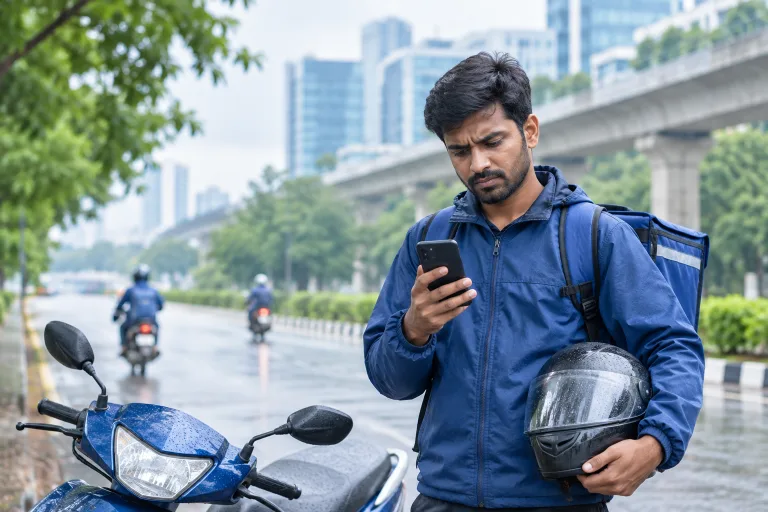
Hang up. No bank, payment app or genuine support person needs the OTP sent to your phone. Reading it out is the same as handing over the account it unlocks. The RBI's advice is to never share your PIN, UPI-PIN, OTP or card details with anyone, bank staff included (RBI, January 2022). If you have already shared one, call your bank and 1930 now.
Why an OTP is the whole game
An OTP is the last lock on a payment or a login. Whoever has it can finish what they started on their own phone: move money from your bank, take over your WhatsApp, or log in somewhere as you. That is why the caller needs you to read it out.
Banks and payment companies never ask for your password, PIN, OTP or CVV (RBI, June 2020). So any caller who asks has told you who they are.
How the script could use your work as the hook
The RBI describes "vishing": phone calls pretending to be from a bank or e-wallet company, often threatening that your account will be blocked over KYC unless you act now (RBI, January 2022). For someone who earns through a partner app, the same script could easily be given a different costume. The lines below are our own examples, written to show the pattern; they are not quotes from reported cases, and no news report we found describes OTP calls aimed at delivery riders. Treat any call like these as a red flag:
- "Your partner account is blocked. Tell me the OTP to reactivate it."
- "Your weekly payout is stuck. I'm sending a code to release it."
- "We need to verify your ID for the next shift, read me the number we just sent."
- "Your KYC has expired, your payouts will stop today."
Whatever the reason, the ask is the same: a code from your phone. If you think there really is a problem with your account or payout, contact support yourself, through the company's own app, not through the number that called you.
OTP frauds in Bengaluru are falling but haven't gone away: police recorded 1,860 cases in 2022, 617 in 2025 and 392 till June 2026, in a category that covers fake KYC updates, malicious app links and phishing messages (Deccan Herald, as of August 2026).
The code-dialling trick
A newer trick doesn't ask for the OTP at all. The I4C, the Home Ministry's cybercrime centre, warned in December 2025 that fraudsters pretending to be delivery or courier agents ask people to dial a code sent by SMS that starts with *21* followed by a mobile number. Dialling it switches on call forwarding, so calls from your bank, payment OTP calls and WhatsApp or Telegram verification codes go to the fraudster's phone (I4C advisory, December 2025).
The I4C's advice:
- don't dial any code starting with
*21*,*61*,*67*or similar that an unknown caller gives you; - if call forwarding may be on, dial
##002#to cancel all call forwarding; - don't click suspicious delivery or courier links that come by SMS, WhatsApp or email;
- report it on 1930 or cybercrime.gov.in.
Riders make delivery calls all day, so it is easy to forget this trick works on you too. If a "courier" calls you about a parcel and asks you to dial something, don't.
If you already shared an OTP
Move fast, in this order:
- Call your bank and report any transaction you didn't make, so the card, account or wallet can be blocked (RBI, January 2022).
- Call 1930 if money has gone. Then complete the complaint on cybercrime.gov.in within 24 hours: our guide on how to report on 1930 has the steps.
- Dial
##002#to cancel any call forwarding the caller may have set up (I4C advisory, December 2025). - Change your passwords and UPI PIN from your own phone, and log out of other devices where your apps allow it.
- Tell your contacts if your WhatsApp may have been taken over, so nobody sends money to "you".
Lock down your SIM
Your phone number carries your bank OTPs, so check that nobody else has a SIM in your name. On the government's Sanchar Saathi portal (as of October 2026):
- Know Mobile Connections in Your Name shows every mobile connection taken on your ID, and lets you report any you didn't take or don't need. One person can hold at most 9 connections across all operators.
- Chakshu lets you report a suspected fraud call, SMS or WhatsApp message, including fake KYC and payment calls. It is not for money already lost: for that, use 1930.
- Block Your Lost/Stolen Mobile Handset blocks a lost phone, which matters because your bank and work apps are on it.
Your phone number and bank account are also part of your joining papers, so keep them in your own name: our documents guide explains what Bengaluru delivery companies ask for. OTP calls are one of the tricks in our guide to fake delivery job offers in Bangalore, which also covers task scams, fake recruiters and deposit demands.
